
The Nebraska Public Records Act
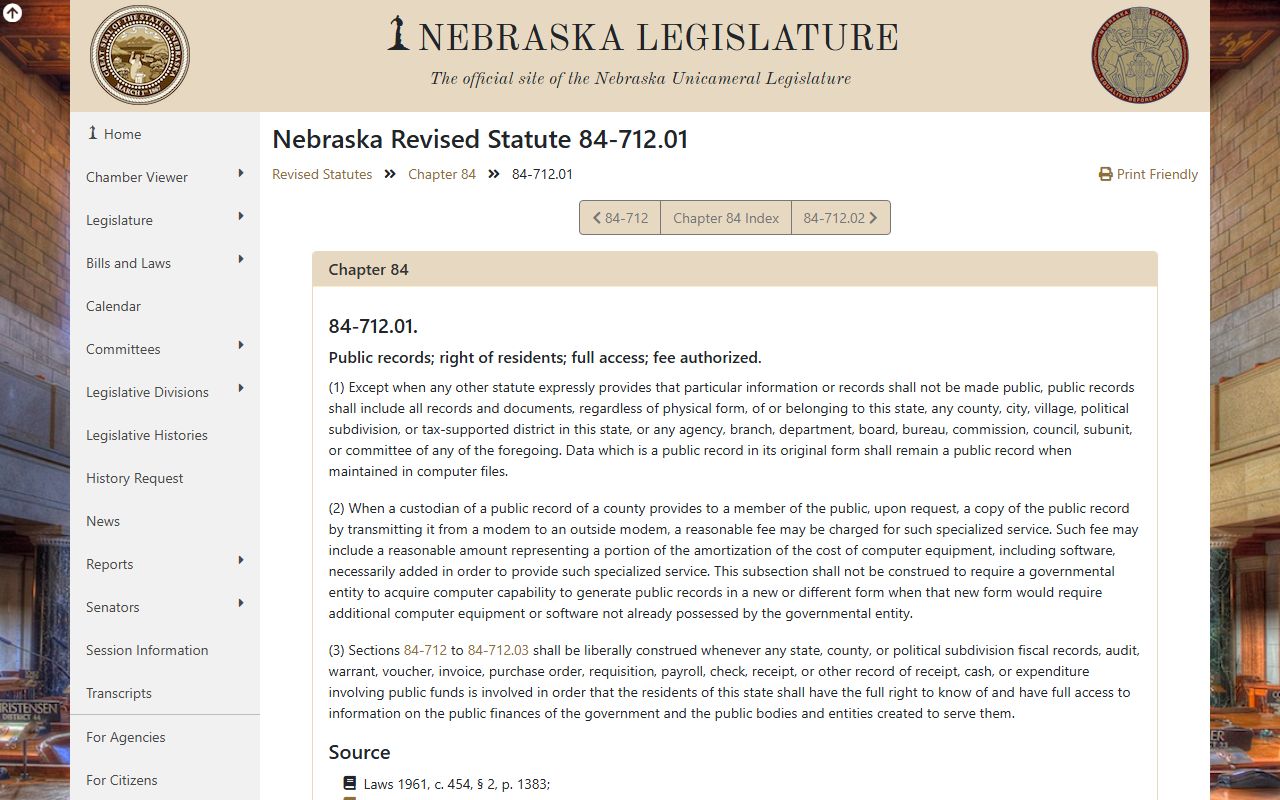
Nebraska's public records law begins with full access. The core statute at Neb. Rev. Stat. 84-712.01 defines public records broadly as records and documents, in any physical form, that belong to the state, a county, a city, a political subdivision, or a tax-supported district. The same statute says data that is public in its original form stays public when it is kept in a computer file.
Any person may request a Nebraska public record. The requester does not have to be a Nebraska resident, and does not have to give a reason. The law does carve out exemptions, and court case files follow a separate set of Nebraska Supreme Court rules rather than the records act. The practical result in Douglas County is that a person uses the records act for county administrative records and uses the court system for case files.
The records act is not the same as the federal Freedom of Information Act. For Douglas County and Nebraska records, the right term is the Nebraska Public Records Act, not FOIA. FOIA applies to federal agencies only.
What Douglas County Offices Maintain
Douglas County records are spread across several offices. The Clerk of the District Court holds civil, criminal, and divorce case files. County Court holds probate, traffic, and small claims. The County Clerk and Comptroller holds marriage licenses and county board records. The Register of Deeds holds property and lien records. The Sheriff and Department of Corrections hold law-enforcement and custody records.
- Court case files: Clerk of the District Court and County Court.
- Marriage licenses and county board minutes: County Clerk and Comptroller.
- Deeds, mortgages, and liens: Register of Deeds.
- Budgets, payroll, and contracts: county administrative offices.
- Jail roster and custody records: Department of Corrections.
- Warrants and civil process: Sheriff's Office.
Vital records such as birth and death certificates have stricter access rules and route through the Nebraska Department of Health and Human Services for certified copies, even though some are recorded locally.
How to File a Public Records Request in Douglas County
A Nebraska public records request can be made in writing, by email, or in person. A clear, specific request gets a faster answer than a broad one. The request goes to the office that actually holds the record, not to the county as a whole.
- Identify the office that holds the record. Court files go to the clerk; deeds go to the Register of Deeds; board minutes go to the County Clerk.
- Describe the records you want, with names, dates, a date range, and any case or document number.
- Submit the request by mail, email, or in person to the office that holds the record.
- Wait for the response. The agency has four business days to respond under state law.
- Pay any copy or labor fee the agency charges, then receive the records.
For court case files, the Nebraska JUSTICE one-time case search at nebraska.gov/justicecc is often faster than a written request, since it returns the docket and document images for $17 without a wait.
Public Records Request Fields
A written Douglas County records request does not have to use a special form, but it should include the items below. A clear request is harder for an office to delay or deny.
| Field | Required | Notes |
|---|---|---|
| Requester name and contact | Yes | Name, mailing address, phone, and email for the response. |
| Description of records | Yes | Be specific. Name the office, the record type, and any case number. |
| Date range | Recommended | Narrows the search and lowers labor fees. |
| Format preference | Optional | Paper copy, electronic file, or in-person inspection. |
| Fee limit | Optional | State a dollar cap so the office contacts you before a large charge. |
Response Timelines
The Nebraska denial and enforcement statute at Neb. Rev. Stat. 84-712.03 sets the response window. A public body generally has four business days to provide the record, deny the request with a reason, or explain a delay. The agency cannot simply ignore a request.
If the record needs significant time to gather, the agency can give an estimate of when it will be ready. A flat refusal has to point to a specific legal reason. A reader who gets no answer at all has a stronger case for enforcement than one who gets a reasoned delay.
Public Records Fees in Douglas County
Nebraska allows a public body to charge for copies and, in some cases, for the time it takes to find and prepare records. The fee has to be reasonable. Court copy charges are separate and follow the clerk's schedule and the statewide court cost schedule.
| Item | How It Is Set |
|---|---|
| Per-page copy | Reasonable cost set by the office; verify the current rate. |
| Staff search and review time | Allowed in some cases under the records act; ask for an estimate first. |
| Certified copy | Higher than a plain copy; required for legal use. |
| Electronic file | Often lower than paper; ask whether email delivery is free. |
| Court case copies | Set by the clerk and the statewide fee schedule. |
The Nebraska Judicial Branch filing fees and court costs page lists the current court charges. For non-court county records, ask the office for a written fee estimate before the work begins.
Records That Are Exempt
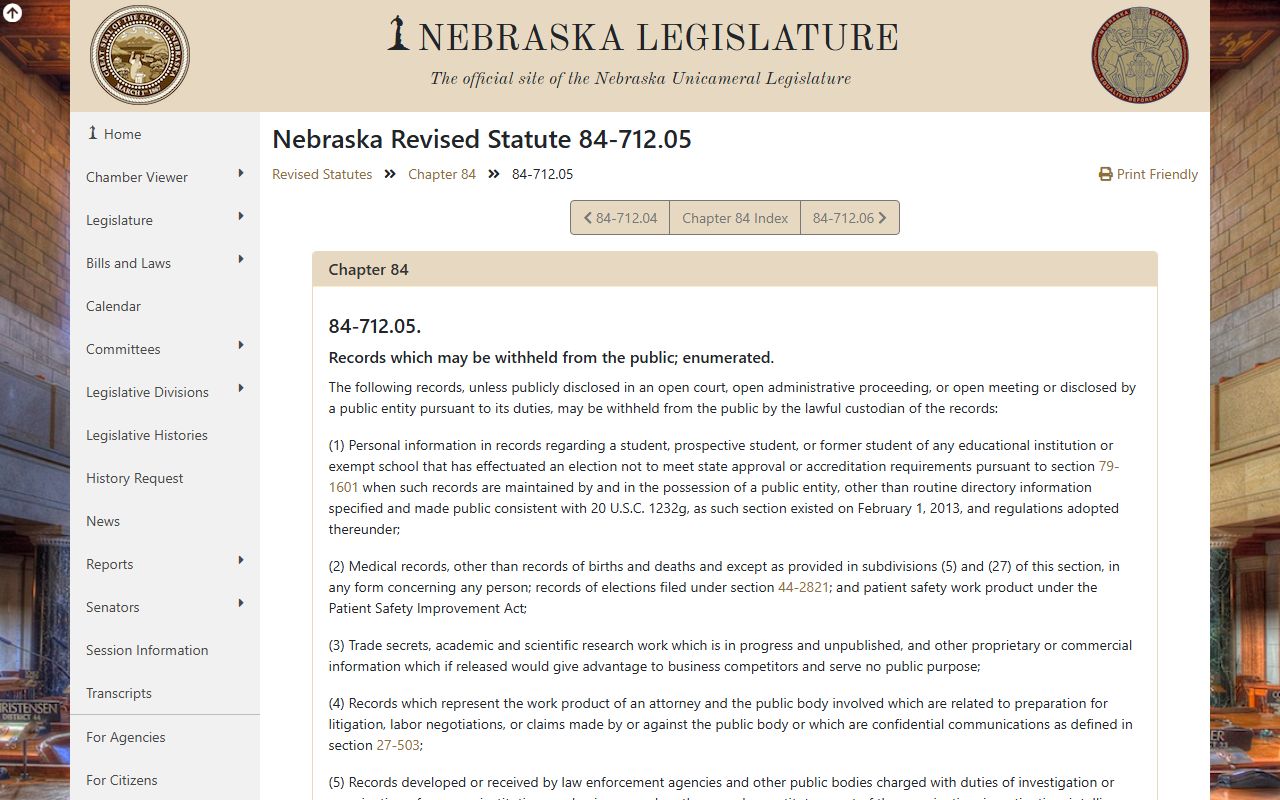
Nebraska law lets a public body withhold some records. The exemptions statute at Neb. Rev. Stat. 84-712.05 lists categories that may be kept from disclosure, including certain law-enforcement investigative records, security information, trade secrets, and personal information where privacy outweighs the public interest.
Court records have their own restrictions. Sealed cases, juvenile records, adoption files, mental health commitments, and protected personal or financial information in civil cases are not open to the public. An absent document online may reflect a privacy rule, not a database error.
If Your Request Is Denied
A denied Nebraska public records request can be challenged in district court. The records act allows a court to order release and, in some cases, to award attorney fees and costs to a requester who wins. The enforcement route runs through the courts rather than a federal office.
The Nebraska Attorney General can also issue a public records disposition letter in some disputes, which can resolve a standoff without a lawsuit. A requester who gets a denial should keep the written request and the written denial, since both matter in any later challenge.